
A business can have a well-controlled main entrance and still have a security weakness just a few steps away.
Think about what happens around a typical commercial property after the front office gets busy. Employees use side entrances. Deliveries arrive at the loading dock. Vendors enter through service doors. Customers move through parking areas. Contractors may need access after normal business hours.
These areas can receive far less attention than the main entrance.
That overlooked space is what we can call the “security gap.” For businesses evaluating Commercial Security in Houston, closing that gap means looking beyond the front door and considering how people, vehicles, and access points move throughout the entire property.
What Is the Security Gap?
The security gap is the difference between the areas a business actively monitors and the areas it assumes are secure.
A front entrance may have cameras, controlled access, reception staff, or security personnel. Meanwhile, a rear door may simply have a lock. A loading area might be busy during the day but largely unattended later. A parking lot may have cameras but no one actively watching what is happening there.
This does not automatically mean a property is unsafe. It means there may be areas where visibility, access control, or response capabilities are weaker.
Effective business security starts by identifying those differences.
A useful security assessment should consider the entire movement pattern of a property: where employees arrive, where deliveries are received, where visitors wait, which doors are rarely used, and what happens when the building is closed.
Why Back and Side Entrances Matter
Back and side entrances are often necessary for normal business operations.
A warehouse may receive deliveries through a rear loading area. An office building may have a separate employee entrance. A retail property may have service personnel coming and going throughout the day. A restaurant may rely heavily on a rear delivery door.
The challenge is that convenience can make these areas harder to control.
For example, employees may prop open a door while moving equipment. Vendors may arrive without a clear verification process. Service personnel may require temporary access. After-hours workers may use entrances that receive little supervision.
Parking areas also deserve attention. A security plan that protects the building but ignores the route employees and visitors take to reach it leaves an important part of the property outside the security picture.
How Commercial Security in Houston Can Close These Gaps
A stronger approach combines people, procedures, technology, and consistent observation.
Access monitoring can help businesses determine who is entering restricted areas and whether access is appropriate.
Security patrols provide another layer of visibility, particularly around parking lots, loading zones, perimeter areas, and secondary entrances.
Entrance and exit monitoring can help identify unusual activity, unauthorized access attempts, or doors that are being used outside normal patterns.
Visitor management creates a clearer process for vendors, contractors, and guests who need access to the property.
Suspicious activity detection is also important. Security personnel can observe behavior and conditions that cameras alone may not interpret effectively.
For businesses considering Commercial Security in Houston, the goal is not simply to put a guard at the front door. It is to create reasonable coverage across the areas where people, vehicles, and property actually move.
Houston Police Department resources also emphasize practical crime-prevention measures for businesses, including burglary prevention, parking lot security, alarms, cameras, and Crime Prevention Through Environmental Design (CPTED).
Common Security Weak Points Around Commercial Properties
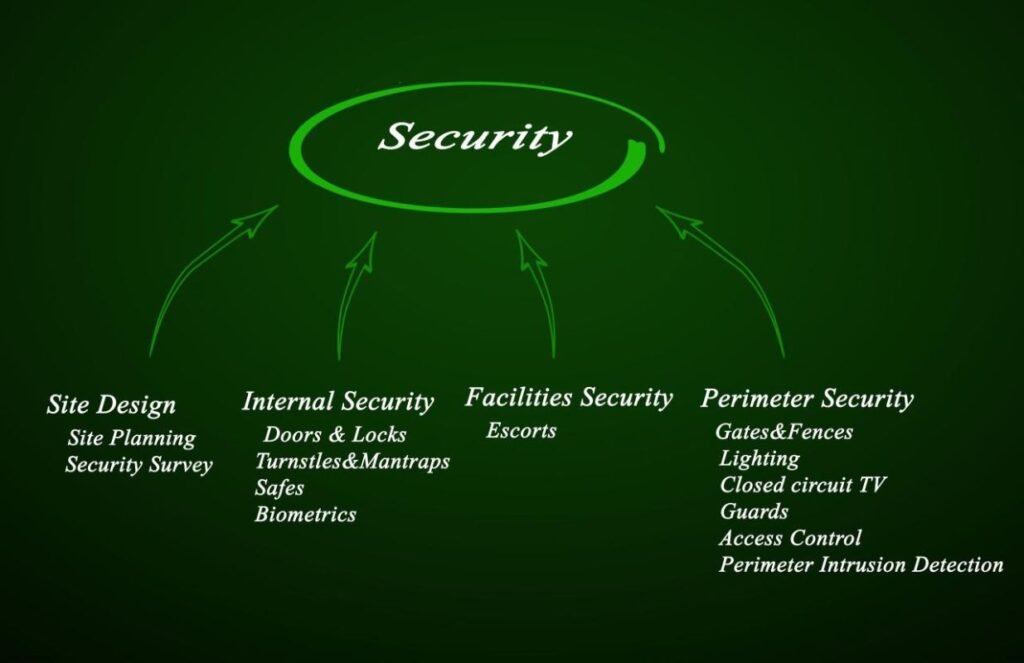
Several areas deserve a closer look during a commercial property security review:
- Rear service doors: Often used frequently but monitored less than the main entrance.
- Loading docks: Regular interaction with vendors, drivers, and deliveries can make access management more complicated.
- Employee entrances: May operate outside normal customer-facing hours.
- Parking lots: Employees and visitors can spend significant time away from the building itself.
- Side gates and perimeter areas: These can create less-visible routes around a property.
- Mechanical or utility areas: Restricted spaces should have appropriate access controls.
- Poorly observed corners: Landscaping, structures, or property layout can reduce natural visibility.
A professional Commercial Security in Houston strategy should identify these overlooked areas and determine which ones require additional monitoring, access control, or security patrols.
Building a Stronger Commercial Security Plan
A practical Commercial Security in Houston plan should begin with a property walkthrough.
Map the entrances and exits. Identify who uses each access point and when. Review delivery procedures. Look at parking and pedestrian movement. Check whether lighting and visibility support natural surveillance. Determine how incidents would be reported and who would respond.
It is also useful to review the plan periodically because businesses change. New tenants, construction, expanded operating hours, new delivery procedures, or changes in staffing can create new vulnerabilities.
OSHA recommends evaluating workplace conditions and implementing appropriate prevention and control measures where workplace violence risks can be identified.
For Houston businesses, local resources can also provide useful crime-prevention guidance. The Houston Police Department’s business-focused resources include information on burglary prevention, parking lot security, alarms, cameras, and CPTED.
Protect More Than the Front Door
The strongest commercial security plan does not end when someone walks through the main entrance.
It considers the loading dock, employee entrance, parking lot, side gate, service door, perimeter, and every other place where people or property move through the business.
That is the real lesson behind the security gap: the most important vulnerability may not be the door everyone watches. It may be the one everyone assumes someone else is watching.
If your Houston commercial property has multiple entrances, parking areas, delivery zones, or after-hours operations, Commercial Security in Houston can help provide a more complete approach to protecting the property.
Thông tin hữu ích quá. Letco tự hào là công ty tư vấn du học Hàn Quốc uy tín, cam kết đồng hành đến khi bạn nhập học thành công. Xem thêm tại letco.vn.